Removal, trimming, ice-storm cleanup, and stump grinding across Gaffney and Cherokee County.
Call (555) 555-5555Or call — we answer. No obligation, honest advice.
Drive I-85 past the Peachoid and you're looking at Cherokee County's whole story in one water tower: this was orchard country, the ground that once out-grew the entire state of Georgia in peaches. The orchards have thinned over the decades, but the trees never left. Gaffney's older neighborhoods carry a mature canopy of oaks and maples planted when the mills were running, the rural roads are lined with pines pushing into red clay, and more than a few backyards still hold a peach or pecan somebody's grandparents put in.
Upstate Gaffney Tree Service works all of it — removals when a tree becomes a liability, trimming that keeps limbs off roofs and lines, cleanup when winter ice or a summer thunderstorm redecorates the yard, and stump grinding so the lawn goes back to being a lawn.
Free written estimates, cleanup included in the number, phones answered. Call (555) 555-5555.
Upstate piedmont clay holds trees differently than sandy ground. When it's dry, it grips like concrete; after a week of winter rain, it softens enough that a tall pine with a full crown can lever its own root plate loose. That's why so many upstate tree failures happen at the roots rather than the trunk, and why a new lean after wet weather is never a cosmetic issue.
Reading the ground is part of every estimate here — what the clay is doing this season decides how a tree gets rigged and dropped.
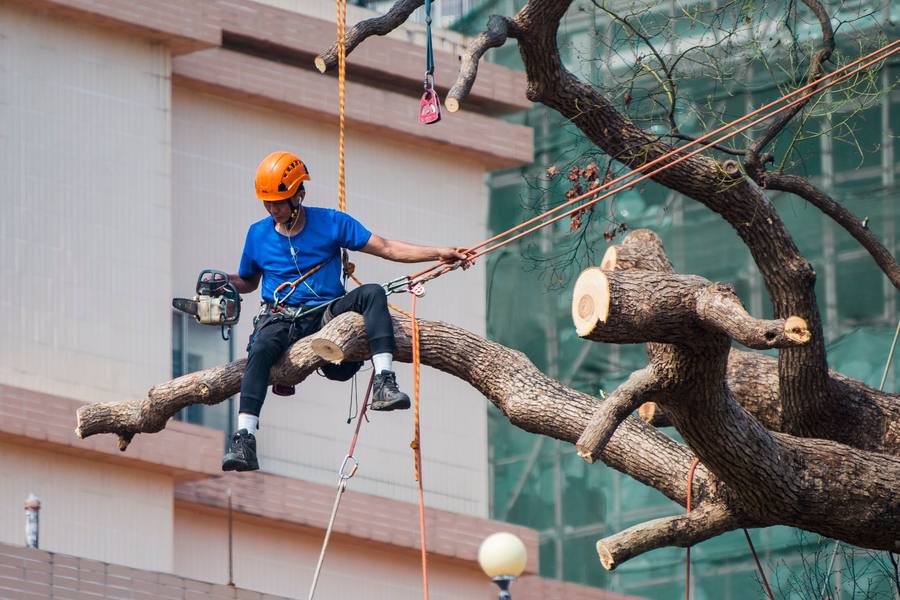
Three services cover most of what Cherokee County trees ask for. Each has its own page with the full picture.
Dead, storm-split, and leaning trees brought down in sections, including tight drops between houses in the older neighborhoods off Limestone Street.
Deadwood out, roofline and driveway clearance, and correct structural cuts — including the orchard-style knowledge fruit trees actually need.
Stumps ground below grade so you can sod, replant, or just mow straight across where the tree used to be.
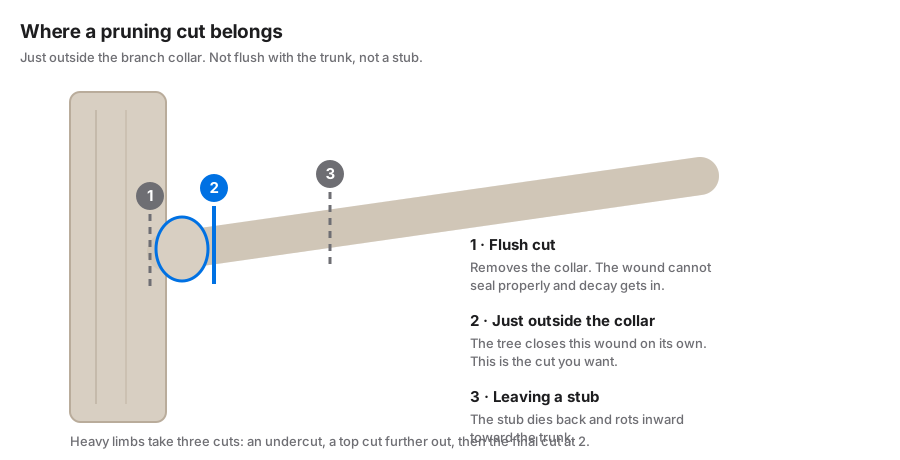
Every limb has a branch collar — the swollen ring where it meets the trunk — and the collar is where the tree keeps its healing tissue. Cut just outside it and the wound closes over in a season or two. Cut flush to the trunk and you've opened a door that never fully shuts; leave a long stub and you've built a decay straw pointed at the heartwood.
Gaffney's peach-country roots make this town unusually familiar with pruning done right — orchard trees live or die by it. The same discipline applies to the red maple over your driveway.
Topping — shearing the whole crown flat — is the one 'service' worth refusing from anyone who offers it. The regrowth is weakly attached, fast, and more dangerous than what was removed.
Coastal South Carolina fears hurricanes; the upstate fears freezing rain. Cherokee County sits right in the elevation band where winter systems flip from cold rain to ice, and a half inch of glaze multiplies the weight of every limb enormously. Pines shed whole tops. Bradford pears — planted by the thousand in subdivisions — split at their narrow crotches almost on schedule. Water oaks drop limbs that were secretly dead all summer.
The best ice-storm work happens in October, not January: deadwood removed, over-extended limbs shortened, and weak unions addressed before the weight arrives. A crown that's been thinned properly carries ice; a neglected one becomes the reason the power's out on your street.
After a storm, the dangerous phase is cleanup. Limbs hung in the canopy, trunks under spring tension, and anything near a service drop are professional territory — a bent-over trunk stores enough energy to move faster than any person can. The chainsaw injuries that fill emergency rooms after ice events overwhelmingly happen in the days after the storm, not during it.
And a caution that arrives with every disaster: crews from out of the area canvassing door to door. South Carolina doesn't license tree work at the state level, which makes your own verification the whole safety net — ask for a certificate of insurance sent directly from the insurer, and be suspicious of any price that only exists today.
Power restoration in the upstate almost always waits on tree crews before line crews — the limbs come off the lines first, then the repairs start. Homeowners who handled their crown work in the fall aren't just protecting a roof; they're shortening their whole street's outage.
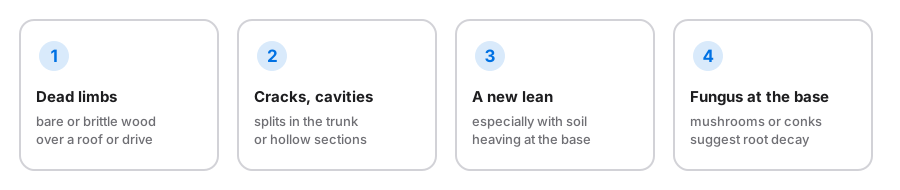
Dead limbs, cracks or cavities, a fresh lean, and mushrooms at the base — any one of them means the tree deserves an evaluation before the next storm tests it.
The same sequence on every job, whether it's one limb over a porch on Petty Street or a boundary-line oak out toward Cowpens.
Someone looks at the actual tree and writes the price down, with hauling and cleanup included rather than appearing later.
Which trees, which limbs, how low the stumps go, what happens to the wood — agreed before a saw starts.
Debris hauled, chips managed, gates closed. The job isn't done when the tree is down; it's done when the yard looks right.
Gaffney's historic residential blocks — the homes built between the 1890s and the 1930s when limestone and textiles paid the bills — come with trees planted in the same era. A ninety-year-old willow oak two stories over a ninety-year-old roofline is a genuine asset and a genuine engineering problem at the same time.
Removals in those yards are rigging jobs: sectioned from the top, lowered on lines, dropped nowhere. Preservation is usually the better answer anyway — cabling a split union or reducing an over-extended limb costs a fraction of removal and keeps the shade that makes those streets worth living on.
The Revolutionary War ground around the county — Cowpens battlefield, the Overmountain Victory route — is a reminder that some trees here have been standing longer than the country. The ones worth keeping deserve work done to a standard that lets them keep standing.
If you own one of those houses, walk the yard each fall with the same eye you'd give the roof: look up for dead limbs over the walkways, look at trunks for new cracks, and look at the ground for mushrooms flushing at the root flare. Fifteen minutes of looking, once a year, catches most problems while they're still trimming money instead of removal money.
Based in Gaffney and covering Cherokee County — the in-town neighborhoods, the I-85 corridor out to the Peachoid and beyond, and the rural roads toward Blacksburg, Chesnee, and the North Carolina line.
On the fence about whether your address is covered? Call and ask. Cherokee County isn't that big; the answer is yes.
Peach capital of South Carolina, seat of Cherokee County, an hour down I-85 from Charlotte.
Plenty of Gaffney yards still hold a peach, an apple, or a fig that predates the current owners. Fruit trees aren't pruned like shade trees — they're pruned for light, air, and fruiting wood, on a calendar, with restraint. A shade-tree crew that 'cleans up' a peach in July can cost you two seasons of fruit and invite disease through every cut.
If the tree matters to you, say so when you call. Work on fruiting trees gets scheduled for the right season and cut to orchard logic, not landscape logic. And if what you want is advice on whether an old tree can be brought back into bearing, that conversation is free.
A leaning pine, a limb on the roofline, storm debris, a stump you're tired of mowing around — whatever it is, call (555) 555-5555 and describe it. You'll get a free written estimate and a real arrival window, and the yard gets left cleaner than the job found it.
Trees give warnings before they fail. The estimate is how you find out which kind you have.
Tell us what you need and we'll get back to you with a real answer. If it's an active backup or standing water over the field, calling gets you a faster response.
Call: (555) 555-5555
Area: Gaffney, SC and Cherokee County